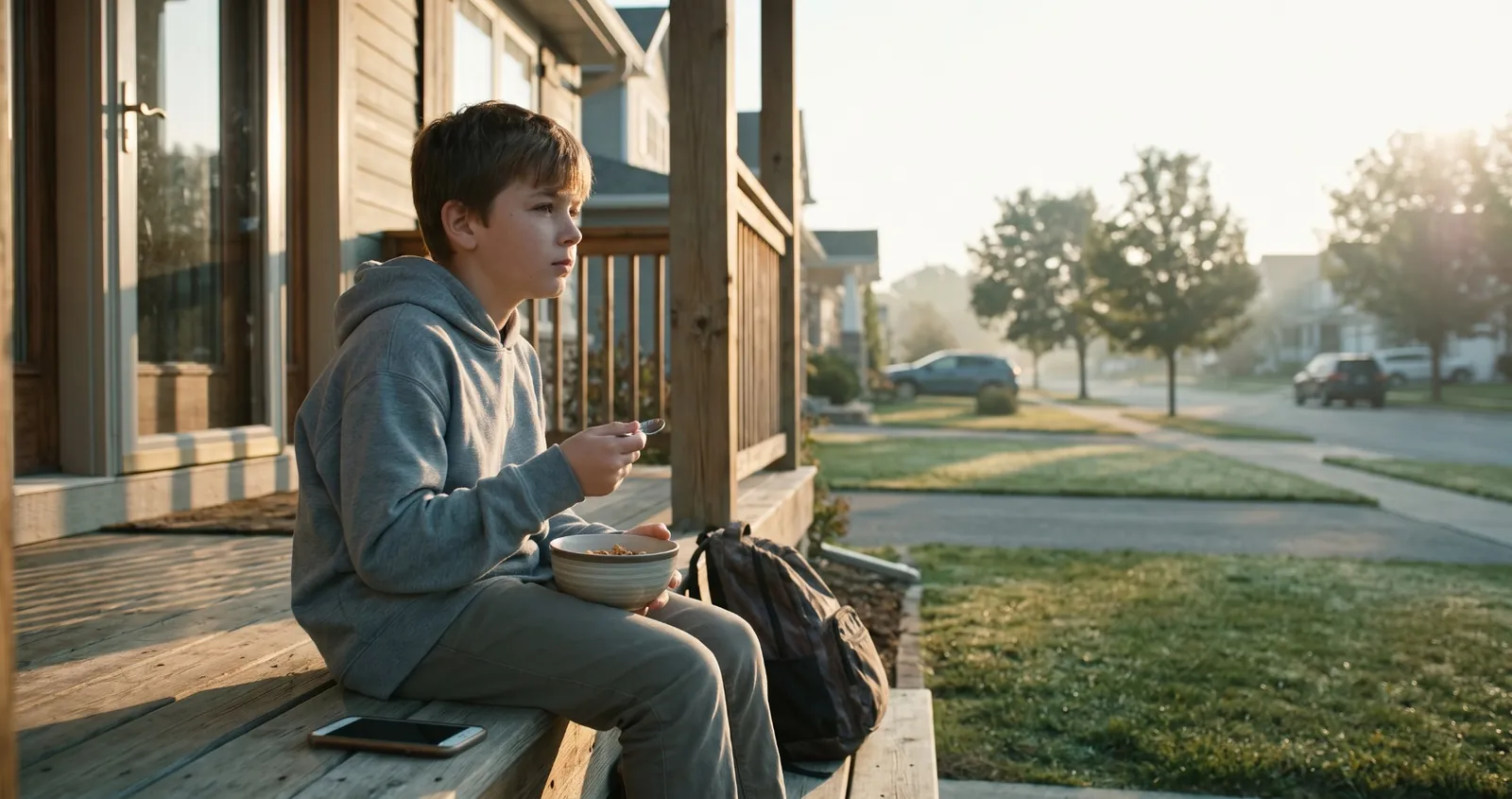
Most parents walk into their kid’s first season expecting a straight line. Bigger every year. Stronger every year. More coordinated, more confident, more capable, one clean upward slope from six to seventeen. That’s the picture the whole system is built around: registration forms, tryout cutoffs, travel team invitations, the assumption that a kid who was gifted at ten stays gifted at fourteen because why wouldn’t they.
That line doesn’t exist. It never did.
What actually happens
Development undulates. It rises, it plateaus, it dips, and for most kids, it dips hardest right in the middle of adolescence, somewhere between twelve and fifteen. Not because something went wrong. Because something enormous is happening inside them that has almost nothing to do with sport.
The graphic at the top of this post shows two versions of the same child. One line follows the expected shape when nobody adjusts for what adolescence actually is. It drifts down and never fully recovers, out of sport by the time it should be peaking. The other line dips through the same window and comes back up, because someone stayed close enough to see the dip for what it was and held load steady instead of walking away or pushing harder. Same child. Same biology. Different outcome, driven entirely by whether the adults around them could see what was happening.
The brain is rebuilding itself
Adolescence is the second most significant period of brain development a person goes through, behind only the first five years of life. Developmental scientists studying this window describe a wave of neural reorganization on par with early childhood: myelination, synaptic pruning, and rewiring of the connections between the prefrontal cortex and the rest of the brain, all happening while the young person using that brain is expected to keep performing on schedule (Dahl et al., Nature, 2018; National Academies of Sciences, Engineering, and Medicine, The Promise of Adolescence, 2019).
That rebuild isn’t quiet. Focus, emotional regulation, risk tolerance, and confidence all move while the wiring behind them is still under construction. A kid who showed up gung-ho and locked-in at eleven can look like a different kid at fourteen, more hesitant, more reactive, harder to read, not because their character changed but because the machinery producing their behavior is mid-renovation.
The body is outrunning the brain’s control of it
At the same time, the body is growing faster than the nervous system can keep up with. Peak height velocity, the fastest window of vertical growth in adolescence, typically lands around age eleven and a half in girls and thirteen and a half in boys (Padua et al., 2024). Boys can grow up to twelve centimeters (about 4.7 inches) in a single year during this window. Bones lengthen before muscles, tendons, and the neuromuscular system finish adapting to the new dimensions, producing what researchers call adolescent awkwardness: a real, measurable, temporary drop in coordination and balance right as sport is asking for more precision, not less (Borato et al., Sports Health, 2025).
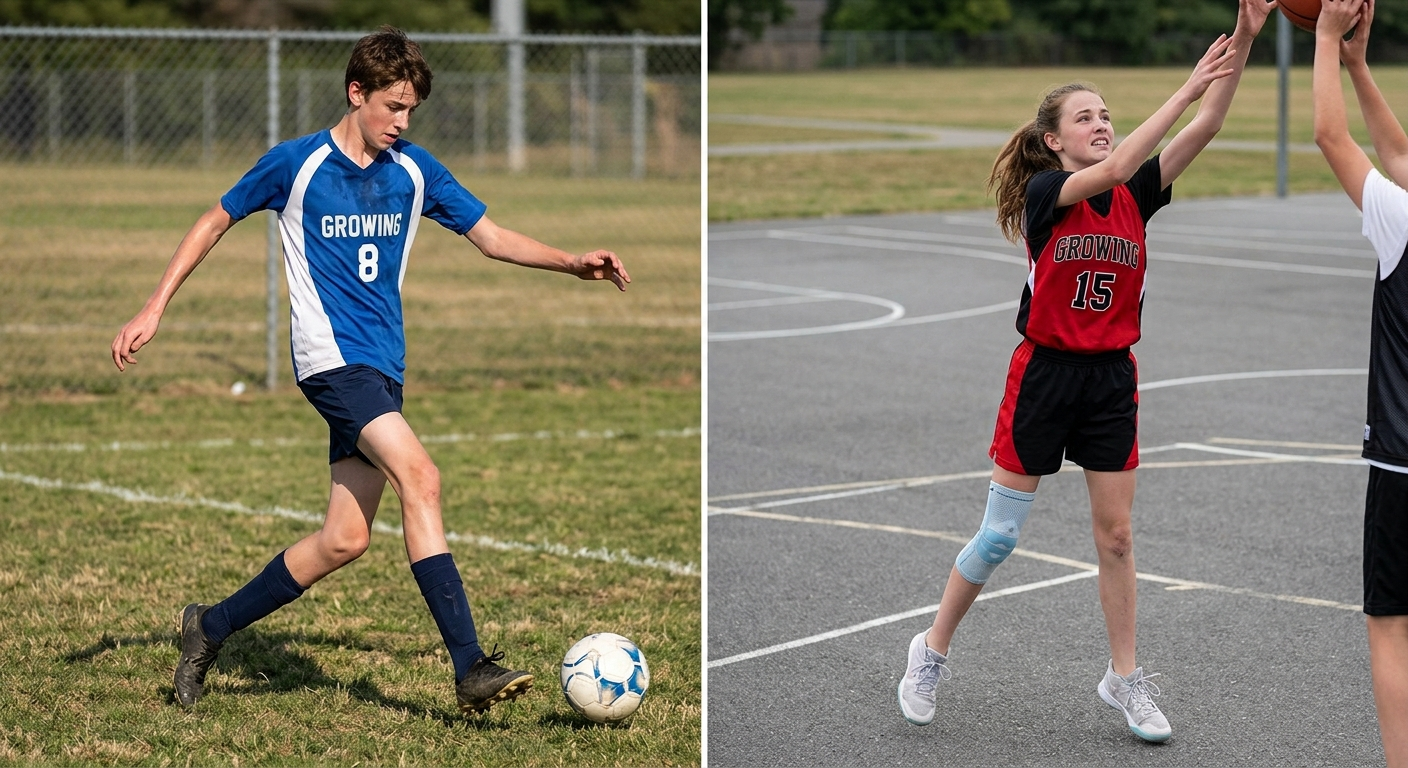
This isn’t cosmetic. Adolescents who have grown more than 0.6 centimeters (about a quarter of an inch) in the previous month carry a 1.63-fold increase in injury risk (Rommers et al., cited in Science and Medicine in Football, 2020). Athletes assessed mid-peak-height-velocity show significantly higher injury rates than those pre- or post-growth spurt (Monasterio et al., 2023). The kid who was once tight and controlled through a movement pattern is, for a stretch of months, genuinely less able to control the body they’re now living in. Taller doesn’t mean readier. It usually means the opposite.
Why nobody sees it coming
Here’s the part that doesn’t show up in the research and probably should. Adolescence is famously hard to recognize from the inside while you’re living it, and just as hard to recognize from the outside once you’ve lived through it yourself. Most parents went through their own version of this dip. Most weren’t shown much grace or understanding while it happened. And because the pattern is so easy to forget once you’re on the other side of it, that same lack of grace tends to repeat itself with the next generation, not out of unkindness, but because nobody stopped to name what was actually going on the first time around.
Coaches face a different version of the same blind spot, and it’s less about patience than time. A club is under pressure from other clubs. A coach is under pressure from parents whose kids happen to be moving through this window on an easier timeline, or haven’t hit it yet at all, and whose development still looks like that clean upward line. Individual timing varies enormously. Two thirteen-year-olds on the same team can be years apart biologically. The system rarely has room to hold both.
And certain sports have almost no patience for this window at all. Adolescence is precisely when individual sports start separating who gets selected, who gets the second training block added to their day, who becomes worth the investment. A single morning session becomes a morning and an evening session. Miss one and the message, spoken or not, is that you’re not committed. Meanwhile sleep and recovery, the two things a rapidly rebuilding brain and a rapidly growing body need most, get treated as optional around a schedule that was never built with either one in mind.
The sport sees a kid who grew six inches and reads it as an opportunity: more size, more physicality, more reason to load them harder and push for more impact, because more impact means more wins, and more wins mean more attention for the kid and the family. Nobody goes back and checks whether the control and strength kept pace with the size. The body gets billed for growth it hasn’t finished paying for yet.
What the data says happens next
This is the part of the story that shows up in the numbers. Participation in organized sport falls from 82% in seventh grade to 39% by twelfth (Sports Health, 2024). The average age a child leaves organized sport altogether is twelve, the exact center of this window (Project Play, 2026). It is not a coincidence that the dropout curve and the adolescent development curve land in the same place. A system that expects a straight line and gets an undulating one interprets the dip as decline, and either pushes the kid to perform through it or quietly stops investing in them. Either way, a lot of kids who were never actually failing get treated like they were.
What changes when someone can see it
None of this means the dip is dangerous or that a kid moving through it is falling behind. It means the dip is normal, and the only thing that determines whether a kid comes out the other side ready or gone is whether anyone around them could tell the difference between a temporary developmental cost and a real decline.
That’s the entire premise behind R1. It doesn’t take a snapshot and assume the line stays straight. It follows a child day after day, through the growth, through the awkward stretch, through the seasons where everything looks a little off for reasons that have nothing to do with effort or character, and it gives the adults around that child the language to hold steady instead of guessing. Not more pressure when a kid slows down. Not less attention when they don’t. Just an accurate picture of what’s actually happening, at the moment it’s happening, so the response can match the reality instead of the expectation.
The same child can end up in two very different places by seventeen. The biology is the same either way. What changes the outcome is whether anyone was paying close enough attention to see the dip coming, and patient enough to wait it out.
Dahl, R. E., Allen, N. B., Wilbrecht, L., & Suleiman, A. B. (2018). Importance of investing in adolescence from a developmental science perspective. Nature, 554, 441-450.
National Academies of Sciences, Engineering, and Medicine. (2019). The Promise of Adolescence: Realizing Opportunity for All Youth. Washington, DC: The National Academies Press.
Borato, L. A., Whatman, C., Walters, S., & Read, P. (2025). What do we know (and not know) about adolescent awkwardness in youth sports? A narrative review. Sports Health.
Monasterio, X., et al. (2023). Peak height velocity and injury risk in youth athletes. As cited in maturity-associated training load research.
Rommers, N., et al. Growth rate and injury risk in adolescent athletes. As cited in Science and Medicine in Football (2020), maturity-associated considerations for training load, injury risk, and physical performance in youth soccer.
Sports Health (2024). Participation decline from 7th to 12th grade cohort study.
Valenzuela-Moss, J., Sini, M., Wren, T. A. L., & Edison, B. R. (2024). Changes in sports participation, specialization, and burnout from 7th to 12th grade: Final results from a 6-year longitudinal study. Orthopaedic Journal of Sports Medicine.
Project Play, Aspen Institute (2026). Average age of sport dropout in the United States.
Note: growth-timing figures (PHV averages by sex) are drawn from adolescent gait and maturation literature; treat as representative ranges rather than fixed thresholds for any individual athlete.
R1 was built for this window.
R1 follows your child’s readiness day after day (Mind, Body, and Energy) so a normal developmental dip looks like what it is, not like decline.